
GenAI Literacy Isn't Usage
Field Notes EP1: It's not which model you use — it's how you design the system around it.

This is the first Field Note — a new short-form series running alongside Inference in the Wild and Causal Inference from the Ground Up. These are reflections from the day-to-day of working as a senior data scientist: the small judgment calls, recurring failure patterns, and "wait, why does everyone default to X?" moments that don't always need a full essay.
🚨 Using genAI tools is not the same as being genAI literate.
A lot of teams are drifting toward the same instinct:
Use the biggest model.
Make it the default.
Route everything through the most powerful API.
Don't worry about cost — just "leverage genAI."
But that is not literacy.
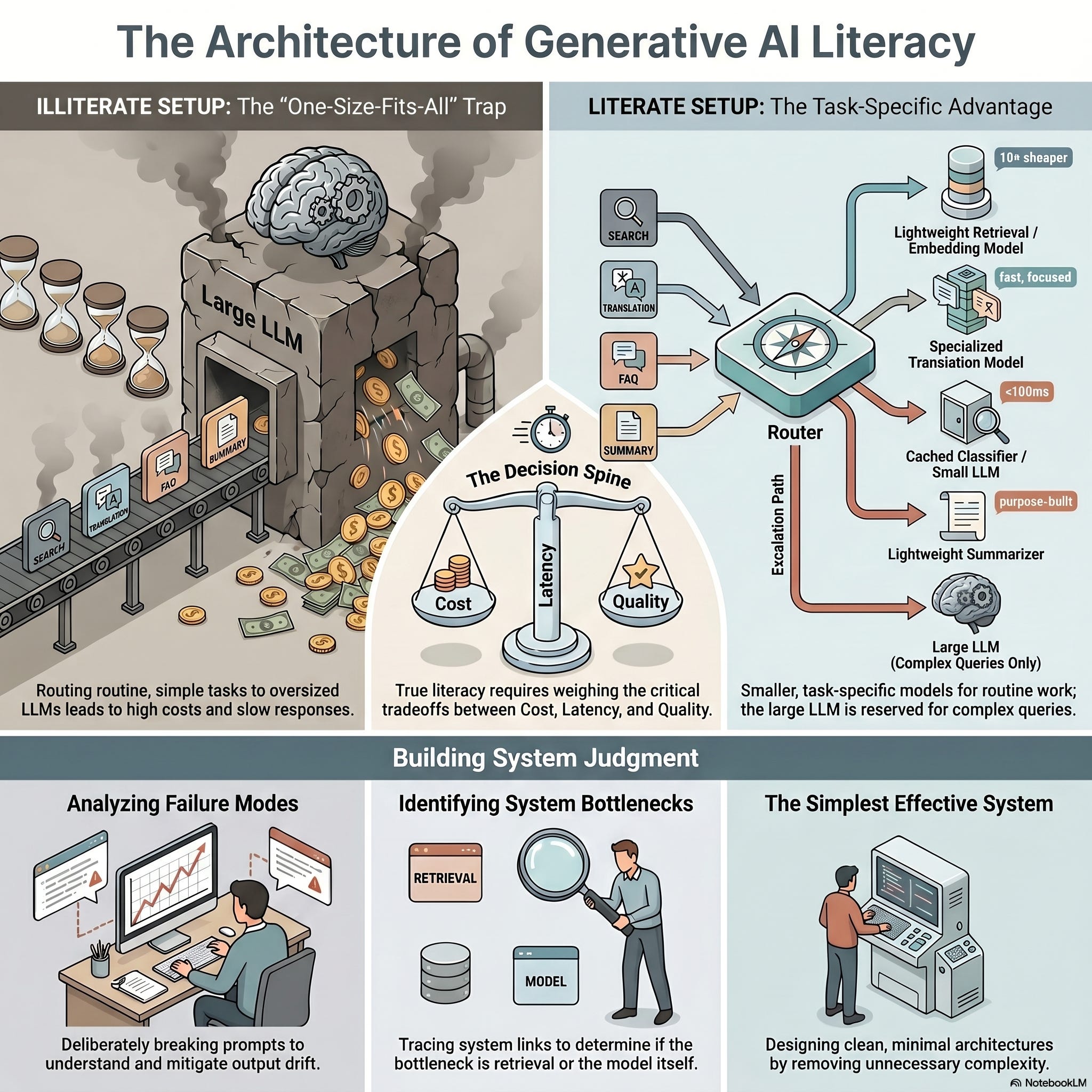
🧠 Real genAI literacy is about judgment — understanding tradeoffs in cost, latency, and quality.
Take a simple example:
❌ Illiterate setup:
→ route thousands of routine queries to a large, expensive LLM
→ high cost, slow responses
✅ Literate setup:
→ use a smaller, task-specific model where possible
→ faster, cheaper, often just as effective
Same problem. Very different system.
That matters even if you are not building frontier models.
Most of us won't train foundation models.
But many of us will design systems around them.
And that requires more than just using tools.
It requires building judgment:
🔍 breaking prompts to understand failure modes
📉 tracking output drift over time
🧩 knowing when the bottleneck is retrieval, not the model
⚖️ choosing the simplest system that works
Just using genAI at work is not enough.
The people who will stand out are not the ones calling the largest model by default.
They are the ones who understand how the system behaves — and make better decisions because of it.
🧭 GenAI literacy is not about usage. It's about knowing how to design the system behind it.
© 2026 Lin Jia. All rights reserved. This content is created independently on personal time and is based exclusively on public domain academic knowledge. No proprietary, confidential, or employer-owned materials, data, or intellectual property are included. The views and opinions expressed in this work are strictly my own and do not reflect those of any current or former employer. All methodology discussed is sourced from publicly available scientific literature.